Simple Answer: AI that works with limited supervision. It is given a goal and set to work to accomplish that goal, finding the quickest path to that goal. ‘Agentic’ refers to the AI model’s ‘agency’ and capacity to act independently for a purpose.
Agentic AI can ‘not only tell you the best time to climb Mt. Everest given your work schedule, but it can also book you a flight and a hotel.’ – IBM.
Referred to as ‘agents’, the agentic AI models are able to conduct repetitive tasks that would usually drain the time of employees, such as data entry. Other, more complex agents are able to problem solve using pattern recognition and memory from which they learn. This sometimes informs other agents in a ‘hierarchy’ to form sequential workflows.
Agentic AI and Construction
Pressure is mounting in the construction industry to be more efficient in a time when costs are rising, margins are tightening, and competition is fierce. An industry ruled by the manual, construction has a reputation for being slow to adapt to new technology. But as things progress, it is clear that those who embrace technology like management software and AI will pull ahead of the pack.
So, how does agentic AI help? It is expected that it could streamline supply chain management as well as automate ordering, production schedules and monitor inventory levels.
Think of this example from Oracle:
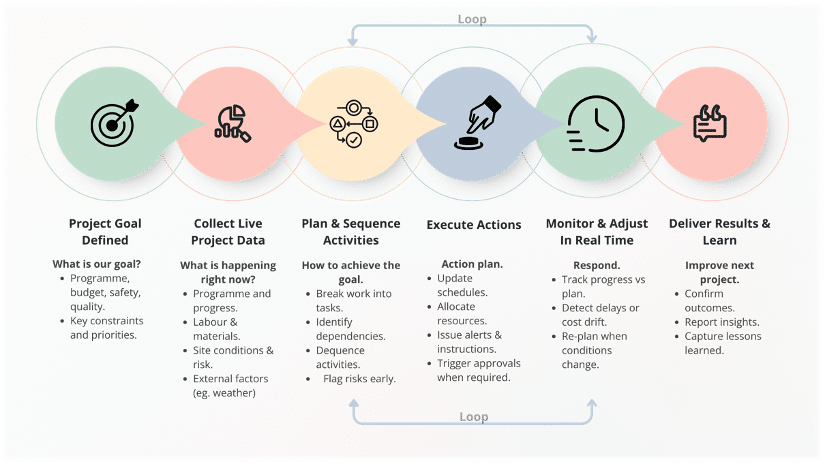
Two agents aid in monitoring several factors that often disrupt projects, causing delays and loss.
- Risk Agent: Monitors weather, news and supply chain dynamics to get ahead of barriers to the planned schedule.
- Scheduling Agent: Builds a schedule based on the Risk Agent’s information to ensure projects stay on schedule, accounting for potential risks.
These agents work together, each feeding each other information about this project and others it has learnt from. By doing this, it can predict issues before they arise, allowing them to be solved before they become a problem. This prediction is taken one step further, as agentic AI can then put in place and execute plans to correct these issues. Timelines, resources and costs can be automatically changed and those working on them notified, to ensure a smooth delivery of the project.
Taking this a step further, an agent can be set to monitor site cameras for safety concerns, such as missing PPE and overcrowding. If a concern is flagged by the agent, it is logged, and actions are taken to prevent this shortfall in the future. These agents can adjust schedules to avoid overcrowding or book an in-person safety check to ensure regulations are followed and training is kept up to date.
Agentic AI is in its early stages, able to work in controlled cases, and is not fully autonomous in all scenarios. Its current use is in handling multistep tasks in customer service, IT, and data analytics. But given the pace at which AI tools are being developed and improved, it is likely that it will be only a short time before it is capable of much more.
Many of the leading players in construction software are moving towards the integration of these tools, helping to develop, improve and make use of them.
Want to know more about what we are doing with AI research? Get in touch.